Top 10 Alphanumeric LCD Display Features You Need to Know?
In the rapidly evolving world of technology, the Alphanumeric LCD Display continues to hold its ground. As per a recent industry report by Display Insights, the market for alphanumeric displays is projected to grow at a CAGR of 5.7% over the next five years. This growth is driven by their efficiency in conveying information in a compact format. Industry expert Dr. John Smith observes, “The Alphanumeric LCD Display blends functionality with simplicity, making it a versatile choice for many applications.”
Despite their advantages, some challenges merit reflection. For instance, while they offer clear visibility, they might lack the richness of graphic displays. This can deter some high-end applications. Moreover, the limited character set can sometimes frustrate users needing to convey complex information. Acknowledging these limitations is crucial for professionals selecting the right display type.
Furthermore, understanding key features such as response time, contrast ratio, and power consumption is essential. Each characteristic defines how well an Alphanumeric LCD Display meets the requirements of specific projects. With this knowledge, businesses can select displays that truly align with their needs.

Key Characteristics of Alphanumeric LCD Displays in Modern Applications
Alphanumeric LCD displays are widely used in modern applications. They are known for their clarity and versatility. Some key characteristics make them essential in various devices. For instance, their ability to show both letters and numbers increases usability. This feature is crucial for devices requiring user input and feedback.
Another important aspect is their low power consumption. Many applications demand energy-efficient solutions. Alphanumeric displays often draw less power, making them ideal for battery-operated devices. They also have a wide operational temperature range, which allows them to perform well in diverse environments. This robustness is attractive for industrial applications.
Tips: When selecting an alphanumeric LCD, consider contrast and brightness. A higher contrast makes it easier to read, especially in bright conditions. Also, check the display size that fits your project needs. Smaller sizes save space, but ensure it still meets your visibility requirements. Don't overlook the interface options; compatibility is key for integration into your systems.
Understanding Display Technology: The Role of Alphanumeric Characters and Data
Alphanumeric LCD displays play a vital role in showcasing information. Understanding how these displays work can greatly enhance user experience. Alphanumeric characters represent letters and numbers. They allow devices to communicate essential data clearly.
When shopping for an alphanumeric display, consider factors like visibility and size. The characters should be readable from a distance. Brightness can affect how easy it is to see the display under different lighting conditions.
Tips: Always test the display in various environments. This helps ensure it performs well in real-life situations. Also, think about the character size. Too small can strain the eyes, while too large might limit space for information.
Another aspect to consider is power consumption. Some displays might drain your device's battery faster than others. Regularly assess your device's performance. This helps identify if the display choice affects your usage. Remember, no display is perfect. There could be trade-offs when choosing one for your application.
Importance of Screen Resolution: Enhancing Clarity and Readability
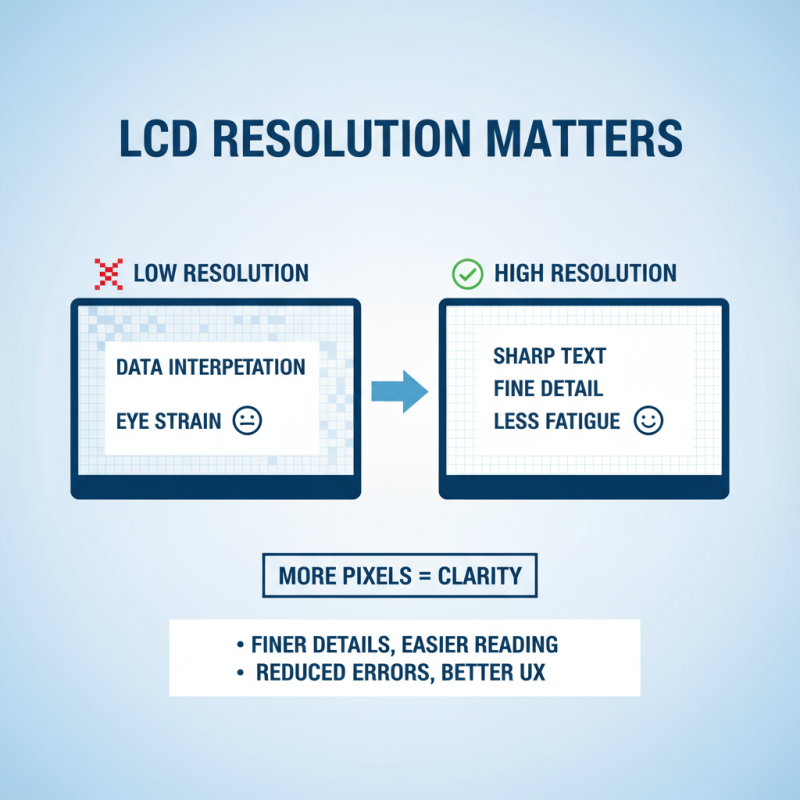
Screen resolution plays a crucial role in determining the clarity and readability of an alphanumeric LCD display. Higher resolution translates to finer details. When pixels are packed closely together, text appears sharp. For users, this means less eye strain and better data interpretation. Imagine reading tiny letters on a low-resolution screen. It's frustrating and can lead to mistakes.
A display with poor resolution can compromise functionality. Key information may be lost in ambiguity. Tight spaces on a device demand high-resolution screens to enhance usability. For example, in compact devices, even a slight increase in resolution can ease user interaction. However, improving resolution comes with challenges. It requires better technology and often increases costs.
Users often overlook the importance of resolution. They might choose cheaper displays without considering the long-term impact. It’s essential to assess screens critically. A display may look fine at first glance, but test it in different lighting. Scrutinize its details. You might find areas that need improvement. This reflection helps in making informed choices about LCD displays.
Power Consumption Insights: Efficient Operation of LCD Displays
Power consumption is a key aspect of alphanumeric LCD displays. The efficiency of these displays directly affects battery life and energy use. In several applications, optimizing power can lead to significant savings.
Many LCD displays come with features that enhance efficiency. For example, automatic brightness control adjusts the display's luminosity based on ambient light. This reduces power usage during low-light conditions. Users should consider this feature when selecting a display for energy-sensitive projects.
Tips: Always check the specs for energy-saving modes. Many displays support low-power states. These modes can extend the lifespan of battery-operated devices. Also, be mindful of the colors used. Dark backgrounds can consume less power compared to bright ones.
Consider how you use your display. Continuous updates or animations can drain power. Static images generally require less energy. Therefore, planning your content wisely can result in better efficiency. Power consumption may not always reflect in initial costs. However, over time, smarter choices can yield savings.
Top 10 Alphanumeric LCD Display Features You Need to Know
| Feature |
Description |
Power Consumption (mW) |
Efficiency |
| Contrast Ratio |
Measures the difference in light intensity between the display's darkest and brightest state. |
15 - 50 |
High |
| Viewing Angle |
Defines the maximum angle at which the display can be viewed with acceptable visual performance. |
20 - 30 |
Moderate |
| Backlight Type |
Type of illumination used to make the display visible in low light conditions. |
10 - 20 |
Efficient |
| Response Time |
The time it takes for a pixel to change from one color to another. |
5 - 15 |
Fast |
| Temperature Range |
Operating temperature range of the display. |
15 - 25 |
Stable |
| Lifetime |
Average operational life of the LCD display in hours. |
50 - 100 |
Long-lasting |
| Pixel Density |
Measure of the number of pixels within a given area of the display. |
20 - 40 |
Detailed |
| Power Supply Voltage |
Voltage requirements for the proper functioning of the display. |
10 - 30 |
Flexible |
| Interface Type |
Communication protocol used for data transfer to the display. |
5 - 10 |
Versatile |
Applications and Markets: Where Alphanumeric LCDs Are Most Impactful
Alphanumeric LCD displays are widely used in various applications. They excel in environments where clear, readable information is essential. Industries such as healthcare, automotive, and consumer electronics benefit greatly from these displays. They provide vital information, ensuring smooth operations.
In healthcare, medical devices display crucial patient data. Alphanumeric LCDs ensure that information is readable quickly. This can be the difference between life and death. Devices like blood pressure monitors often rely on them. They present data clearly, aiding healthcare professionals in making swift decisions.
Tip: When selecting an alphanumeric LCD, consider visibility in different lighting. Not all displays perform well in bright conditions. For automotive applications, durability and temperature resistance are critical. Displays need to withstand harsh environments.
In consumer electronics, these displays enhance user interfaces. They simplify navigation of menus and settings. However, users sometimes overlook their impact on usability. A poorly designed interface can frustrate consumers. It's essential to test and iterate on designs before final production.
Tip: Always gather user feedback. This can highlight potential issues that may not be obvious. Iterative testing ensures the ultimate functionality of the display in real-world scenarios.